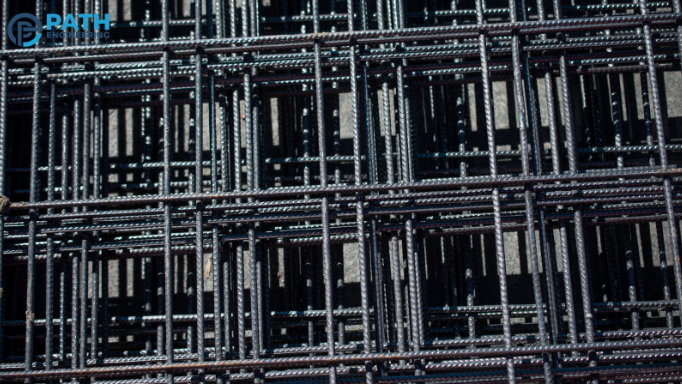
corrosion resistance TMT bars were engineered to solve, and it's worth understanding properly before you're standing on a site comparing brochures.
What Are Corrosion Resistance TMT Bars?
Corrosion resistance TMT bars are thermomechanically treated reinforcing steel bars formulated with controlled micro-alloying elements, typically chromium, copper and nickel, that slow the electrochemical process which causes steel to rust inside concrete. Unlike standard Fe TMT bars, which rely almost entirely on concrete cover and pH for protection, CRS bars build corrosion resistance into the steel's own microstructure, so they hold up meaningfully longer in chloride-rich or industrially aggressive environments. The "CRS" in CRS steel and CRS TMT bars simply stands for Corrosion Resistant Steel, that's the CRS steel full form, and it's a category, not a brand name. Several manufacturers produce their own version of it under different trade names, which is exactly why the underlying chemistry and test data matter more than the label on the bundle.
Why Ordinary TMT Bars Corrode in the First Place
Steel embedded in concrete is, under normal conditions, remarkably well protected. The high alkalinity of fresh concrete forms a thin passive oxide film around the bar that stops rust from starting, and this is why plain reinforcing steel in dry, inland structures can stay corrosion-free for decades, sometimes over a century, according to CRSI's technical guidance on reinforcing bars. That protection breaks down in two common ways:
- Carbonation: Atmospheric CO₂ reacts with the concrete over time and gradually lowers its pH, weakening the passive film.
- Chloride Ingress: Chloride ions from seawater, humid coastal air, or de-icing salts diffuse through the concrete cover and trigger active corrosion.
Once that passive film fails, corrosion doesn't stay a surface problem for long. Rust occupies significantly more volume than the steel it replaces, and that expansion pushes outward against the surrounding concrete, which is why cracking and spalling almost always follow, not precede, the first signs of rebar corrosion. Peer-reviewed modelling of this process shows that the length of time before corrosion starts is governed almost entirely by how fast chlorides diffuse through the cover to reach the bar, which is precisely the mechanism CRS metallurgy is designed to slow down. If you're specifying reinforcement for a coastal, marine, or industrial-exposure project, this is the point where cover thickness and concrete grade alone stop being enough, the bar chemistry needs to carry some of the load.
How CRS TMT Bars Actually Resist Corrosion
The corrosion resistance in CRS TMT bars comes from two things working together, not one:
- Alloy chemistry: Controlled additions of chromium and copper form a more stable, adherent oxide layer on the bar's surface, one that resists breakdown from chloride attack far better than the passive film on plain carbon steel.
- Thermomechanical processing: The quenching-and-self-tempering process used to manufacture TMT bars also produces a refined, uniform outer rim on a CRS bar. A cleaner, more consistent microstructure gives chlorides less of a foothold to initiate localized corrosion.
The result, measured properly, is a significant jump in corrosion resistance rather than a marginal one. Independent lab testing across four separate ASTM-referenced methods, potentiodynamic testing, salt spray exposure, sulphur dioxide exposure, and alternate immersion, has shown CRS TMT bars scoring well over one-and-a-half to more than double the Corrosion Resistance Index of standard TMT bars tested under identical conditions, depending on the test method used. That's the kind of data worth asking for by name, not accepting on faith.
The Recognized Categories of Corrosion Resistant Rebar
Globally, corrosion resistant reinforcement isn't a single product, it's a family, and where CRS TMT bars sit in that family matters for cost and application fit:
Galvanized (zinc-coated) bars
A sacrificial zinc coating protects the underlying steel; effective, but the coating can be damaged during bending and site handling.
Epoxy-coated bars
A polymer barrier coating; widely used in North American infrastructure, but vulnerable to coating damage and holidays (gaps) during fabrication.
Stainless steel bars
The highest corrosion resistance available, at a significant cost premium that limits use to critical, high-value structural elements.
Low-alloy corrosion resistant steel (CRS) bars
Corrosion resistance built into the base metal itself rather than applied as a coating, which means there's no barrier layer to chip, scratch, or fail during transport, bending, or welding on site. These bar designations are formally recognized in industry standards, CRSI references ASTM classifications covering zinc-coated, epoxy-coated, stainless, and low-carbon chromium steel bars, which is also why CRS TMT bars fit cleanly into international specification documents, not just Indian ones.
Where Corrosion Resistant Rebar Isn't Optional
Some structures can get away with standard Fe TMT bars for decades. Others are living in conditions that guarantee accelerated corrosion the day the concrete cures. The difference usually comes down to exposure:
- Coastal and marine structures, jetties, ports, seawalls, and any RCC work within a few kilometers of the coastline, where airborne chloride is a daily reality, not an occasional risk.
- Industrial and process environments, chemical plants, fertilizer units, and oil & gas installations where sulphur dioxide and other aggressive gases attack reinforcement from the atmosphere, not just the water table.
- Bridges, flyovers, and highway infrastructure, structures with 75-100 year design lives where a corrosion-related repair cycle is enormously more expensive than a marginally higher upfront steel cost.
- Basements, water tanks, and below-grade structures, chronically damp environments where carbonation and chloride exposure compound over time.
This isn't a small niche. India's coastline was recently remeasured using modern GIS methods at just over 11,000 km, nearly 50% longer than the figure used for decades, which means the footprint of construction sitting in genuinely corrosive coastal conditions is larger than most project planning still assumes.
The Economics Nobody Puts on the Drawing
Corrosion is one of the highest hidden costs in the built environment. The widely cited NACE International IMPACT study estimated the global cost of corrosion at roughly US$2.5 trillion annually, equivalent to about 3.4% of global GDP, and found that applying available corrosion-prevention practices could recover 15-35% of that cost, hundreds of billions of dollars a year, globally, left on the table simply because the wrong reinforcement chemistry went into the wrong structure. For a project owner, the practical version of that statistic is simple: the price difference between standard Fe TMT and CRS TMT bars is almost always smaller than the cost of one mid-life corrosion repair, let alone a structural remediation. Talk to our experts today!
What to Actually Check Before Choosing a Supplier
The "corrosion resistant steel rebar manufacturers in India" search exists because the label is easy to print and harder to verify. A few things separate a genuine CRS product from a marketing claim:
- Ask for Corrosion Resistance Index (CRI) data across recognized test methods, potentiodynamic, salt spray, SO2, and alternate immersion, not just a single number.
- Confirm the manufacturing route. Primary-route production (integrated DRI-EAF or BF-BOF with controlled chemistry) delivers far more consistent alloy composition than induction-furnace secondary production.
- Check third-party validation. Testing at an independent, NABL-accredited lab or a recognized institute carries more weight than in-house certification alone.
- Match the grade to the exposure, not the other way around, a Fe 500D CRS bar for a coastal residential build has different requirements than an Fe 550D CRS bar for a port structure.
- Review project references. A manufacturer whose CRS bars are already specified in port, highway, or industrial infrastructure has been tested in the conditions you're building for.
Why You Should Choose Path Engineering for CRS TMT Bars
Path Engineering builds corrosion-resistant TMT bars the way the science actually demands, controlled alloy chemistry, consistent thermomechanical processing, and test data you can verify rather than take on faith. For project teams working on coastal, industrial, or long-design-life infrastructure, that difference shows up years later in the structures that don't need mid-life repair. If corrosion exposure is part of your project brief, it's worth a conversation before the reinforcement order is placed, not after. Talk to Path Engineering's technical team about matching the right CRS TMT grade to your project's exposure conditions.
Frequently Asked Questions
What is the full form of CRS in CRS steel or CRS TMT bars?
CRS stands for Corrosion Resistant Steel. It describes a category of reinforcing bar with alloy chemistry engineered specifically to resist chloride- and carbonation-induced corrosion, rather than a single manufacturer's brand name.
Are corrosion resistant TMT bars the same as galvanized or epoxy-coated bars?
No. Galvanized and epoxy-coated bars rely on an applied surface coating for protection, which can be damaged during bending or site handling. CRS TMT bars build corrosion resistance into the base metal itself through alloying and processing, so there's no coating to chip or fail.
Do corrosion resistant TMT bars cost significantly more than standard TMT bars?
There is a price premium, but it's typically modest compared to the cost of corrosion-related repairs later in a structure's life, especially for coastal, industrial, or long-design-life projects where corrosion risk is high from day one.
Which grades are available in corrosion resistant CRS TMT bars?
Common CRS grades mirror standard TMT grades, Fe 500D, Fe 550D, and Fe 600 among them, with the corrosion resistant chemistry layered on top of the same strength and ductility requirements set out in IS 1786.
How can I verify a manufacturer's corrosion resistance claims before ordering?
Ask for Corrosion Resistance Index (CRI) data across multiple ASTM-referenced test methods, potentiodynamic, salt spray, sulphur dioxide, and alternate immersion, ideally validated by an independent, accredited testing lab rather than in-house figures alone.