GFRP Bars in India: Price, Specifications, and How to Choose the Right Manufacturer
GFRP bars (Glass Fiber Reinforced Polymer bars) are composite reinforcement rods made from continuous glass fibers bound in a resin matrix, used as a corrosion-resistant alternative to steel rebar in concrete structures. In India, GFRP bar prices in 2026 typically range from ₹150-₹300 per kg, and the material is increasingly specified for coastal, marine, and infrastructure projects where steel corrosion drives up long-term maintenance costs.
If you're evaluating reinforcement options for a coastal structure, a bridge deck, or any project where corrosion is a long-term liability, GFRP bars aren't a niche alternative anymore but a mainstream specification across Indian infrastructure.
What Are GFRP Bars?
GFRP bars, also called GFRP rebar, FRP bars, or Glass Fiber Reinforced Polymer rebars, are reinforcement rods manufactured by pultruding continuous glass fiber rovings through a resin bath (typically vinylester, epoxy, or polyester) and curing them into rigid, corrosion-resistant bars. Unlike steel, GFRP contains no metallic content, so it cannot rust, corrode electrochemically, or degrade from chloride exposure, the primary failure mode of conventional reinforced concrete near coastlines, in water treatment plants, and in chemically aggressive soils.
A typical GFRP bar combines:
Continuous E-glass or ECR-glass fiber rovings for tensile strength
A resin matrix (vinylester or epoxy for higher-performance applications)
A surface treatment, sand coating or helical fiber winding, for mechanical bond with concrete
Straight or factory-bent configurations (GFRP cannot be field-bent like steel without rupturing)
The result is a bar with tensile strength comparable to or exceeding that of steel, at roughly a quarter of the weight, a property that changes both handling and economics and structural design assumptions on site.
Sourcing GFRP bars for a coastal or infrastructure project? Path Engineering manufactures GFRP bars at scale and unbeatable quality. Speak to our experts today!
GFRP Bars vs. Steel Bars: The Real Comparison
This is the question every engineer asks before switching materials, and the honest answer depends on which metric you're comparing.
Property
GFRP Bars
Steel (TMT) Bars
Corrosion resistance
Immune, no rust, no chloride attack
Vulnerable, especially in coastal/chemical environments
Weight
~75% lighter than steel of same diameter
Baseline
Tensile strength
Comparable to, often exceeding, steel
Baseline (Fe 500/550)
Electrical conductivity
Non-conductive, non-magnetic
Conductive
Field bending
Not possible, must be factory-bent
Bendable on site
Price per kg
3-4x higher than TMT
Lower
Price per running meter
30-45% cheaper than TMT (due to lower weight)
Baseline
Design life
80-100+ years in most environments
40-50 years, less in corrosive zones
The price comparison is where most buyers get misled. Comparing GFRP and steel purely on a per-kilogram basis overstates GFRP's cost, because GFRP rebar is roughly 30-45% cheaper than TMT bar of the same diameter when evaluated on a per-running-meter basis, the metric that actually matters for project budgeting, since GFRP weighs about 75% less than steel of equivalent diameter. Factor in lifecycle costs, zero corrosion maintenance, no rebar replacement, no rehabilitation cycles, and the total cost of ownership case tilts further toward GFRP for any project with a multi-decade service life in a corrosive environment.
Steel still holds advantages GFRP cannot replicate: it can be bent on site, it has established design codes going back a century, and its ductile failure mode (as opposed to GFRP's brittle failure at ultimate load) matters for specific seismic detailing. The honest framing isn't "GFRP replaces steel everywhere", it's "GFRP replaces steel wherever corrosion, weight, or non-conductivity is the deciding constraint."
Why GFRP Demand Is Growing in India
Corrosion isn't a marginal cost in Indian infrastructure but a structural one. Independent estimates put India's annual GDP loss from corrosion at 5-7%, a scale that has pushed both private developers and public infrastructure bodies to look seriously at corrosion-immune alternatives to steel reinforcement. GFRP is one of the few materials that solves the problem at the source rather than managing it after the fact.
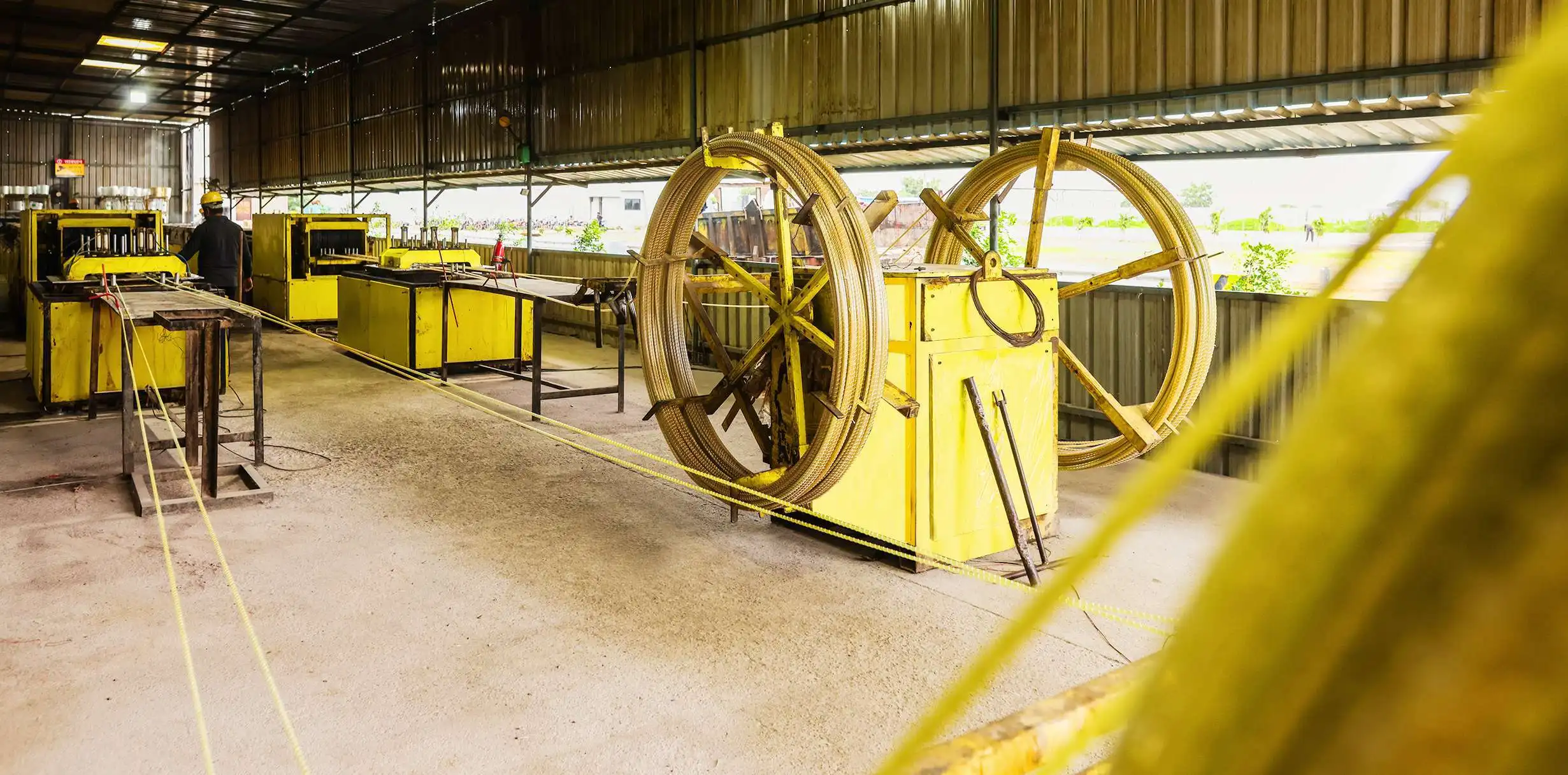
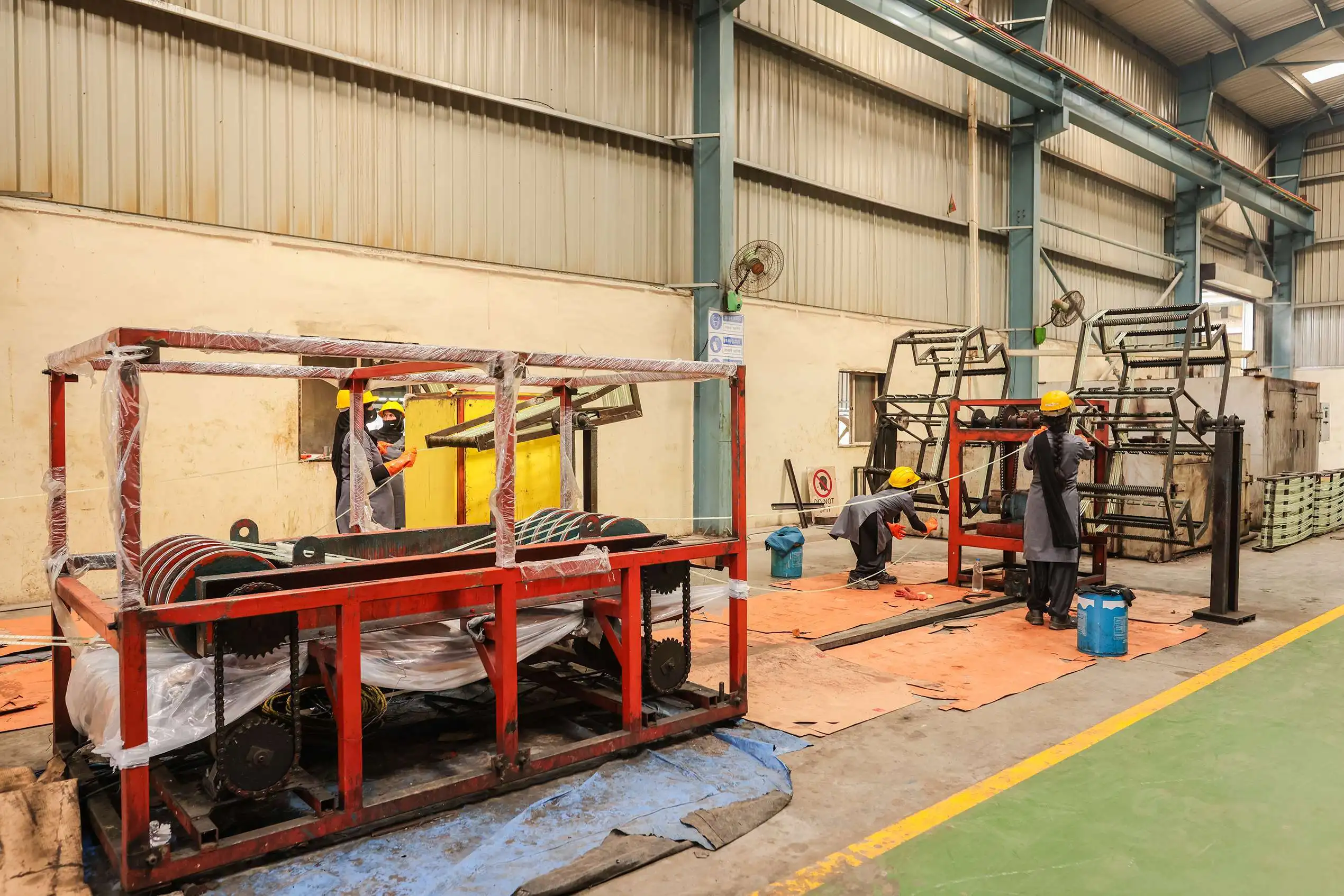
GFRP reinforcement bar production at Path Engineering's manufacturing facility.
The market is responding accordingly. India, alongside China and Vietnam, anchors the Asia-Pacific region's dominant share of the global GFRP rebar market, a region that already commands roughly 45% of global market share, driven by rapid urbanization and government investment in green construction. Regional demand for GFRP rebar across India and Southeast Asia is projected to surpass 120,000 metric tons annually by 2030, representing close to 25% of the global FRP rebar market, on the back of an 8-10% regional CAGR through the decade.
India's regulatory groundwork is now in place too, which matters for anyone specifying GFRP on a government or PWD-approved project:
GFRP bar material specifications are covered under BIS standards IS 18256:2023 and IS 18255:2023
The Indian Roads Congress has published IRC 137:2022, covering FRP bar usage in road construction
NHAI has initiated pilot projects using GFRP rebar on national highways
State PWDs of Gujarat, Rajasthan, Maharashtra, Karnataka, and Andhra Pradesh have approved GFRP rebar for government projects
On the lifecycle-economics side, the case is even starker for coastal work: over a 50-year service period, steel-reinforced coastal structures can cost 3 to 5 times more than GFRP-reinforced structures once maintenance, repairs, rehabilitation, and disruption costs are factored in. For government-funded infrastructure, where budgets are scrutinized over decades, not years, that lifecycle differential is difficult to ignore.
Building for the coastal corridor, a metro project, or any chloride-exposed structure? Path Engineering's GFRP bars are manufactured to meet Indian infrastructure-grade standards.
Key GFRP Bar Properties and Specifications
Beyond corrosion resistance, a handful of properties define where GFRP bars are appropriate:
Tensile strength: Commonly rated above 1,000 MPa, exceeding conventional Fe 500 steel in raw tensile terms
Weight: Approximately one-quarter the weight of an equivalent-diameter steel bar, cutting transport and handling costs significantly
Non-conductivity: No electrical conductivity and no magnetic interference, making GFRP suitable for MRI facilities, substations, and railway electrification zones
Thermal expansion: A lower coefficient than steel in the transverse direction, reducing cracking risk under temperature cycling
Anisotropic behavior: Unlike isotropic steel, GFRP is strong along the fiber direction but weaker transversely, which is why bends must be factory-formed, not field-bent
Chemical resistance: Resistant to chlorides, sulfates, and most soil and groundwater chemical exposure
Applications in Indian Construction
GFRP bars are no longer confined to experimental pilot projects. Current and emerging applications across India include coastal highways and bridge infrastructure under the Sagarmala programme, metro rail projects, precast slabs and deck panels, retaining walls, underground water tanks, culverts and drainage structures, and MIVAN wall systems. The common thread across nearly all of these is exposure, to seawater, groundwater, industrial chemicals, or electromagnetic sensitivity, where steel's vulnerabilities become expensive over a structure's lifetime.
Beyond coastal and marine work, GFRP is increasingly specified in urban metro construction, where tunnel linings and platform structures sit in permanently damp, chemically variable ground conditions that accelerate steel corrosion far faster than above-ground exposure would. Water and wastewater treatment infrastructure is another growing category, chlorine and other treatment chemicals attack steel reinforcement aggressively, making GFRP's chemical inertness a direct maintenance-cost saving rather than a theoretical benefit. Renewable energy infrastructure, particularly solar farm foundations and substation works, also benefits from GFRP's non-conductive, non-magnetic properties, since steel reinforcement near high-voltage equipment introduces both safety and interference considerations that GFRP simply avoids.
GFRP Bar Price in India: What to Expect in 2026
GFRP bar pricing in India in 2026 typically falls between ₹150 and ₹300 per kg, with variation driven by three factors:
Diameter: Smaller-diameter bars (6-10 mm) sit at the higher end of the range because the surface-area-to-volume ratio requires more resin per kilogram; larger diameters (20-25 mm) trend toward the lower end
Resin system: Vinylester and epoxy-based bars command a premium over standard polyester resin systems, reflecting better chemical and thermal performance
Order volume: Bulk and direct-from-manufacturer orders reduce per-kg cost meaningfully versus small retail quantities
The practical advice for procurement teams: don't budget on a per-kg basis alone. Request pricing per running meter, since that's the number that reflects GFRP's actual weight advantage over steel and gives an accurate like-for-like project cost.
How to Choose a GFRP Bar Manufacturer in India
Not every supplier listed online offers infrastructure-grade material. When evaluating a GFRP bars manufacturer, look for:
BIS and IRC compliance
Certification against IS 18256:2023 / IS 18255:2023 and IRC 137:2022 where applicable
In-house QA/QC testing
Tensile strength, bond strength, and resin content should be independently verifiable, not just claimed
Manufacturing scale and consistency
A facility with dedicated production lines reduces batch-to-batch variation risk
Track record on infrastructure-grade projects
Highway, metro, or PWD-approved project experience signals real-world reliability
Direct factory pricing
Sourcing straight from the manufacturer, rather than through multiple trading layers, typically improves both price and lead time transparency
Why Path Engineering for Your GFRP Bar Requirements
Path Engineering (PEIPL) manufactures GFRP bars at a dedicated 12-acre facility in Mhow, Madhya Pradesh, operating 24×7 with a production capacity of 100-120 tonnes per month to serve large-scale infrastructure and private-sector demand across India. The plant runs on in-house QA/QC testing, a precision machine shop, and a team of over 60 skilled engineers and technicians, the same manufacturing discipline Path Engineering has applied for decades as an ISO 9001:2015 certified producer of crash barriers and road-safety infrastructure.
That combination of dedicated capacity, in-house testing, and infrastructure-grade manufacturing standards is what makes Path Engineering a dependable source for GFRP bars on projects where consistency and compliance aren't optional.
GFRP bar prices in India in 2026 typically range from ₹150 to ₹300 per kg, depending on diameter, resin type, and order volume. Smaller diameters (6-10 mm) sit toward the higher end, while larger diameters (20-25 mm) are priced lower per kg. For project budgeting, price per running meter is more accurate than price per kg, since GFRP's lower weight offsets its higher per-kg cost.
Is GFRP better than steel?
Neither material is universally better but the right choice depends on the application. GFRP is superior where corrosion resistance, weight, or non-conductivity is the deciding factor, such as coastal structures, marine environments, and electromagnetically sensitive sites. Steel remains preferable where field bendability, established seismic ductility codes, or lower upfront material cost are the priority.
What is the difference between GFRP and steel bars?
GFRP bars are made from glass fibers in a resin matrix and are corrosion-immune, non-conductive, and roughly 75% lighter than steel, but cannot be bent on site and behave anisotropically (strong along the fiber direction, weaker transversely). Steel bars are isotropic, field-bendable, generally cheaper per kg, and have a well-established century-long design code history, but are vulnerable to corrosion, especially in coastal and chemically aggressive environments.
What is the lifespan of GFRP bars?
GFRP bars are typically rated for a service life of 80 to 100+ years in most environments, compared to roughly 40-50 years for conventional steel rebar, and significantly less in corrosive coastal or chemical-exposure conditions. This extended design life is a primary driver of GFRP's total cost of ownership advantage over steel in long-duration infrastructure projects.
Who manufactures GFRP bars in India?
India has a growing base of GFRP bar manufacturers, ranging from specialized composite producers to established infrastructure companies expanding into composite reinforcement. Path Engineering (PEIPL) manufactures GFRP bars at a dedicated 12-acre, 100-120 tonnes/month facility in Mhow, Madhya Pradesh, backed by in-house QA/QC testing and decades of ISO-certified infrastructure manufacturing experience.